Superhero
A superhero is a fictional character who is noted for feats of courage and nobility and who usually has a colorful name and costume and abilities beyond those of normal human beings. A female superhero is often called a superheroine. more...
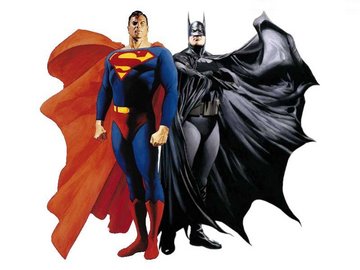
The word superhero comes from Superman, who debuted in 1938, and the stories of superheroes - ranging from episodic adventures to decades-long sagas - have become an entire genre of fiction that has dominated American comic books and crossed over into several other media.
Common traits
Although superheroes widely vary (see Divergent character examples)., a number of characteristics have become associated with the typical superhero:
- Extraordinary powers and abilities, mastery of relevant skills, and/or advanced equipment. Although superhero powers vary widely, superhuman strength, the ability to fly and enhancements of the senses are all common. Some superheroes, such as Batman and Green Hornet, possess no superpowers but have mastered skills such as martial arts and forensic sciences. Others have special equipment, such as Iron Man’s power armor and Green Lantern’s power ring.
- A strong moral code, including a willingness to risk one’s own safety in the service of good without expectation of reward.
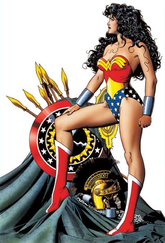
- A special motivation, such as a sense of responsibility (e.g. Superman), a strong sense of justice (e.g. Batman), a formal calling (e.g., Wonder Woman), or a personal vendetta against criminals (e.g., The Punisher).
- A secret identity that protects the superhero’s friends and family from becoming targets of his or her enemies. Most superheroes, but not all, use a descriptive or metaphoric code name for their public deeds.
- A flamboyant and distinctive costume, often used to conceal the secret identity (see Common costume features).
- An underlying motif or theme that affects the hero’s name, costume, personal effects, and other aspects of his character (e.g., Batman resembles a large bat, calls his headquarters the "Batcave" and his specialized automobile, which also looks bat-like, the "Batmobile").
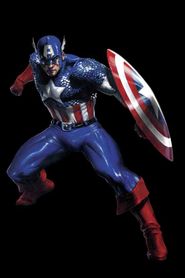
- A trademark weapon, such as Wonder Woman’s "Lasso of Truth" and Captain America’s shield.
- A supporting cast of recurring characters, including the hero's friends, co-workers and/or love interests, who may or may not know of the superhero's secret identity. Often the hero's personal relationships are complicated by this dual life.
- A number of enemies that he/she fights repeatedly, including an archenemy who stands out among the others. Often a nemesis is a superhero’s opposite or foil (e.g., Sabretooth embraces his savage instincts while Wolverine battles his).
- Independent wealth (e.g., Batman or the X-Men's benefactor Professor X) or an occupation that allows for minimal supervision (e.g., Superman's civilian job as a reporter).
- A secret headquarters or base of operations (e.g., Superman's Fortress of Solitude).
- An "origin story" that explains the circumstances by which the character acquired his/her abilities as well as his/her motivation for becoming a superhero. Many origin stories involve tragic elements and/or freak accidents that result in the development of the hero's abilities.
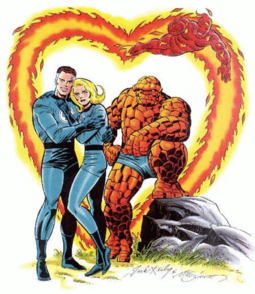
Most superheroes work independently. However, there are also many superhero teams. Some, such as the Fantastic Four and X-Men, have common origins and usually operate as a group. Others, such as DC Comics’s Justice League and Marvel’s Avengers, are "all-star" groups consisting of heroes of separate origins who also operate individually.
Read more at Wikipedia.org