Skulls
A skull, or cranium, is a bony structure of Craniates which serves as the general framework for a head. The skull supports the structures of the face and protects the brain against injury. more...
Humans
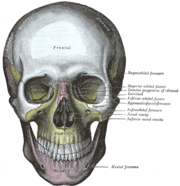
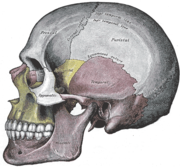
In humans, the adult skull is normally made up of 29 bones. Except for the mandible, all of the bones of the skull are joined together by sutures, rigid articulations permitting very little movement.
Eight bones form the neurocranium (braincase), a protective vault of bone surrounding the brain and medulla oblongata. Fourteen bones form the splanchnocranium, the bones supporting the face. Encased within the temporal bones are the six ear ossicles of the middle ear. The hyoid bone, supporting the larynx, is usually not considered as part of the skull, as it does not articulate with any other bones.
Development of the skull
The skull is a complex structure; its bones are formed both by intramembranous and endochondral ossification. The bones of the splanchnocranium and the sides and roof of the neurocranium are formed by intramembranous (or dermal) ossification, while the bones supporting the brain (the occipital, sphenoid, temporal, and ethmoid) are largely formed by endochondral ossification.
At birth, the human skull is made up of 45 separate bony elements. As growth occurs, many of these bony elements gradually fuse together into solid bone (for example, the frontal bones). The bones of the roof of the skull are initially separated by regions of dense connective tissue called "cranial sutures". There are five sutures: the frontal suture, sagittal suture, lambdoid suture, coronal suture, and squamosal suture. At birth these regions are fibrous and moveable, necessary for birth and later growth. This growth can put a large amount of tension on the "obstetrical hinge," which is where the squamous and lateral parts of the occipital bone meet. A possible complication of this tension is rupture of the great cerebral vein of Galen. Larger regions of connective tissue where multiple sutures meet are called fontanelles. The six fontanelles are: the anterior fontanelle, the posterior fontanelle, the two sphenoid fontanelles, and the two mastoid fontanelles. As growth and ossification progress, the connective tissue of the fontanelles is invaded and replaced by bone. The posterior fontanelle usually closes by eight weeks, but the anterior fontanelle can remain up to eighteen months. The anterior fontanelle is located at the junction of the frontal and parietal bones; it is a "soft spot" on a baby's forehead. Careful observation will show that you can count a baby's heart rate by observing his or her pulse pulsing softly through the anterior fontanelle.
Read more at Wikipedia.org